

When a residential demolition project gets underway, most homeowners focus on what’s coming down — a crumbling garage, an outdated shed, or an addition that’s outlived its usefulness. What often goes overlooked is the legal and financial exposure that surrounds the work zone itself. Temporary fencing for demolition is one of the most critical safety measures we install on every residential project we handle across Eastern Massachusetts and Southern New Hampshire, and the liability protection it provides goes far beyond simply keeping curious neighbors at bay.
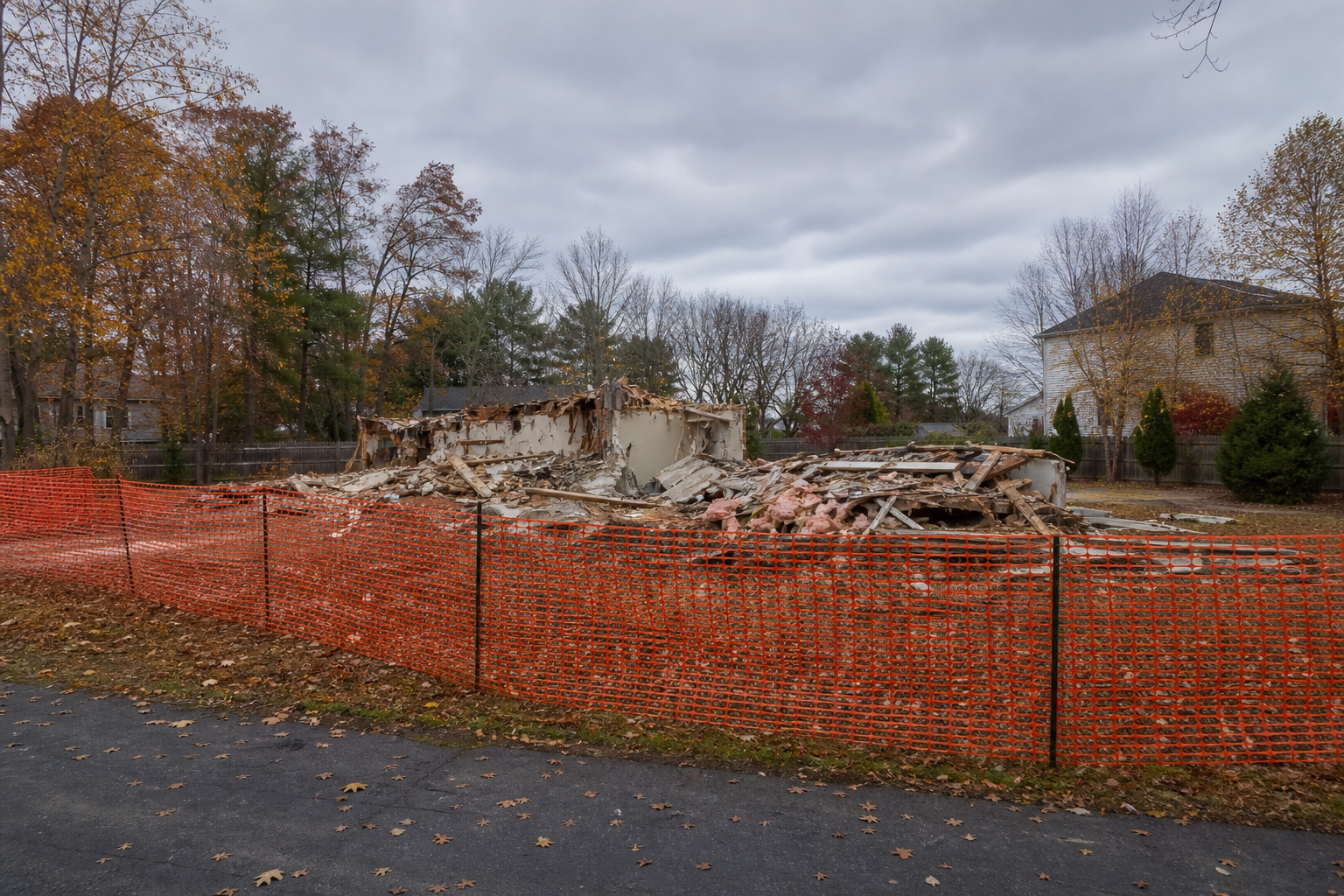
In New England, residential demolition sites carry a unique set of risks. Debris fields, exposed foundations, unstable structures, and heavy equipment create hazardous conditions that can shift quickly — especially as fall weather brings early darkness, wet leaves, and unpredictable conditions that make footing treacherous. When an uninvited person enters an active demolition zone and suffers an injury, property owners can be held legally responsible under premises liability law, regardless of whether that person had any right to be there. This legal concept, known as the “attractive nuisance” doctrine, has caught many homeowners off guard. A partially demolished structure or a deep foundation hole is exactly the kind of hazard that courts have consistently ruled property owners must secure.
Professional temporary fencing creates a documented, physical boundary that demonstrates due diligence. When we establish a perimeter around a demolition site, we are not just keeping people out — we are establishing a clear record that the property owner took reasonable precautions to prevent unauthorized access. Insurance carriers and legal professionals both recognize properly installed perimeter fencing as a meaningful risk mitigation measure. In the event of a dispute or claim, that fencing can be the difference between a covered incident and a costly out-of-pocket liability.
Beyond individual homeowner liability, many municipalities across Massachusetts and Southern New Hampshire require temporary fencing as a condition of obtaining a demolition permit. Failing to meet this requirement can result in work stoppages, permit revocations, and fines that quickly dwarf the original cost of the fencing itself. We navigate these local requirements routinely, ensuring that every installation meets the standards set by the specific town or city where the project is located. That local knowledge is something no homeowner should try to manage alone, especially when the regulatory landscape varies significantly from one municipality to the next.
Our team coordinates temporary fencing as part of a seamless demolition process. From the moment we begin mobilizing equipment to the final debris removal, the perimeter stays secured. Professional demolition services protect more than the structure itself — they protect your investment, your neighbors, and your legal standing throughout the entire project. For projects that also involve public-facing areas or shared driveways, the principles are similar to what we apply in other environments, as outlined in our work on temporary fencing for crowd and perimeter control across New England.
If you have a residential demolition project planned this fall or heading into winter, do not leave your liability exposure unaddressed. Call ABH Services Inc. at (781) 941-2422 or visit us on Facebook at https://www.facebook.com/abhservices/ to discuss how we can secure your site, meet local permit requirements, and protect you from day one through project completion.